Wednesday, June 7, 2017
How the FARC Missed Its Initial Goals - a Sad Story
These days - May 27th 2017 - the world's oldest guerrilla group FARC-EP was 'celebrating' its 53rd anniversary. While anyone else would think that a sober memorial of the FARC's founding in 1964 would be more appropriate, las FARC still see themselves as victors and bringers of peace and social justice in Colombia, something that should be celebrated. Let's look into that and see how true that is.

Thursday, October 13, 2016
How the Colombian Electorate Was Deceived in the October 2nd 2016 Plebiscite About the Peace Accords
A rather amazing and disappointing story about Colombian politics. After Greece 2015, Netherlands 2016, Bahamas 2016, Hungary 2016, Great Britain 2016, once more a referendum got hi-jacked by opportunists, manipulators, populists and politicians with the help of national main stream media and social media as accomplices. Lack of unbiased education on the peace accords by the Colombian authorities, electoral fraud, inability to vote for large voter groups and the probable unconstitutionality of the plebiscite, seem all to have contributed to the deception of the Colombian people. Read More...
Wednesday, June 10, 2015
Improvised Anti Personnel Mines in Colombia
On March 7, 2015 the Colombian government and the FARC-EP reached an agreement to start a demining pilot project in the town El Orejón, Antioquia. Colombia is a nation severely affected by landmines. In 2006 the number of victims was as high as 1,227 of which 237 were reported dead. The accumulated number of victims since 1990 reached the number of 10,812 at the end of 2014. More than 10,000 potentially Suspect Hazardous Areas (SHAs) exist in Colombia. According to government statistics, there are more than 3.6 million
registered Internally Displaced Persons (IDPs) in Colombia, and landmine
contamination is a contributory factor preventing these people from
returning to their land. AP mines have been laid by all Non States Armed Groups (NSAGs) in Colombia as well as the State's Security Forces. Never the less there is also good news. The yearly number of victims is declining fast!
Sunday, January 4, 2015
The Threats to the Colombian Peace Process
The Havana peace process that officially started on November 19th 2012, has lasted more than two years already and just 3 of the 6 agenda points have been agreed upon. The
good thing is that the process is still making progress and the closer
it gets to the finish line, the less chance there is that it will be
aborted. The peace process seems to be the germ of a broad public debate of how to redesign the Colombian state and society.
But unlike what you'd expect, there are serious threats and counter-forces that are undermining the peace process. Lots of groups seem not to favor peace in Colombia. Former president and now senator Álvaro Uribe Vélez seems to be the spearhead of those groups. Let's look at those threats here.
But unlike what you'd expect, there are serious threats and counter-forces that are undermining the peace process. Lots of groups seem not to favor peace in Colombia. Former president and now senator Álvaro Uribe Vélez seems to be the spearhead of those groups. Let's look at those threats here.
Tuesday, November 18, 2014
Venezuela and the Plummeting Oil Price
Venezuela depends on oil sales for over 95% of its export earnings, with the hard currency being used to pay for imports, social programs, external debt and arbitration settlements. As a result the decrease in the price of oil this year has been viewed with concern. Brent crude has fallen from a previously stable US $105 in July down to $78 currently.
 |
| Brent Crude Oil Price in USD/barrel from Nov 2013 - Nov 2014 |
Lower oil prices are an additional strain on Venezuela’s ailing economy. But $75-80 oil won’t send the country into default...yet, but the D-word is being whispered by some analysts.
Wednesday, October 22, 2014
Cheap Bananas from Ecuador
Bananas are the most consumed tropical fruit in the western world. They are very easy to peel and are very comfortable to eat. No dirty hands. Thanks to refrigerated cargo ships (aka reefers) and refrigerated shipping containers, bananas can be shipped around the world without spoilage. Bananas can be cooled and shipped, when harvested green. Refrigeration slows the ripening process. The ripening is usually done in warehouses at the export destination point with ethylene gas. Bananas are cheap and everybody eats them. It's an ideal product to attract shoppers into supermarkets and that is exactly what is happening nowadays in North America and Western Europe. Banana turnover in western supermarkets could be as much as one percent of the overall turnover, which is considered as an awful lot. It seems there is a banana-price-race-to-the-bottom going on in many western countries. Unfortunately with bad side effects.
Thursday, August 14, 2014
Child Migrants from Central America
The White House released a factsheet in June about the rapidly growing numbers of children from Central America unaccompanied by a parent and that are crossing the Mexico-U.S. border. The Administration remains greatly concerned by this rise and mentions that these children are vulnerable, and many become victims of violent crime or sexual abuse along the dangerous journey.
There has been a more than 120 per cent surge in the numbers of Honduran children picked up on the US border compared with 2013. Child migrants from El Salvador have increased more than 100 per cent and from Guatemala by nearly 60 per cent.
Friday, June 13, 2014
US PMCs in Latin America
Mercenaries are not at all a new phenomena in Latin America. Already in the 16th century Latin America was invaded with mercenaries. The Spanish and Portuguese Conquistadors were a special breed of men: brutal, ruthless adventurers who would stop at nothing to carve out wealth and fame for themselves and an empire for Spain. In most cases, the conquistadors were not soldiers from the national armies of these invading countries, but mercenaries who set out on these conquests to build their fortunes with the spoils of war. They had to buy their armor, sword, and horses. However, in some cases the national military of a country would descend upon a native country and wage war with them and then claim the land as theirs. The most famous example of this is Hernan Cortes and his army, which was funded by the nation of Spain in their quest to bring the Aztecs down. Men like Hernán Cortés and Francisco Pizarro left their bloody mark on the New World.
US Private Military Companies (PMCs)
A US PMC is a company that is contracted to deliver military services to the Ministry of Defense (Pentagon) or in some cases the Ministry of State. In essence we're talking about mercenaries, while there can be discussion about the exact definition. The contractors are mostly former well-trained US militaries. They could be advisers, trainers, pilots, service personnel, security guards, reconnaissance or intelligence workers and so on.
Thursday, November 14, 2013
Álvaro Uribe Vélez' Mission
Colombia's ex-president (2002-2010) Álvaro Uribe Vélez has been described as the worst ex-president ever, because he is continuously criticizing his successor President Juan Manuel Santos and the FARC-peace-process by Twitter, Facebook, his website, his Youtube channel and by means of numerous interviews and lectures - in Colombia and abroad - about his political views and his book. His Twitter account has 2.5 million followers as per November 2013, grew 1 million followers the last 12 months and this number is still growing. In October 2012 he admitted in an interview with Jorge Ramos that he is not writing his 20 tweets/day himself, so a PR-assistant is probably taking care of this. Uribe can't be president again, so what is his mission and goal?
Monday, September 16, 2013
Evo Moráles and Bolivia's Lithium Deposits
The Deposit
 |
| Salar de Uyuni, Bolivia Courtesy of Anouchka Unel |
Bolivia's Salar de Uyuni, is the world's largest salt flat at 10,582 square kilometers. It's part of Bolivia's Altoplano at an altitude of 3,656m. The Salar was formed as a result of transformations between several prehistoric lakes. It is covered with a solid salt crust varying in thickness between tens of centimeters and a few meters.The brine below the salt crust is a saturated solution of Sodium Chloride, Potassium Chloride, Lithium Chloride, Magnesium Chloride and Borax in water. Of those, Lithium is most valuable as it is a vital component of many electric rechargeable batteries. With estimated 9,000,000 tonnes, Bolivia holds about 50% of the world's Lithium reserves according to USGS. Salar de Uyuni is estimated to contain 10 billion tonnes of salts. Lithium is concentrated in the brine under the salt crust at a relatively high concentration of about 0.3%.
Sunday, June 16, 2013
The Colombian Llanos Orientales (Eastern Plains) as Part of the FARC Peace Agreement (?)
 |
| Llanos Orientales de Colombia |
Saturday, June 15, 2013
The (Preliminary) Agrarian Reform Agreement of the FARC Peace Talks
It took the FARC and the Colombian government more than 6 months to reach an agreement on the 1st of 6 items of the Peace Process Agenda: Agrarian Reform. It's still a preliminary agreement, because of the condition "that nothing is agreed until everything is agreed" and because the final agreement will be submitted to a referendum of the Colombian people. The full text of the Agrarian Reform agreement was not disclosed so few details could be renegotiated later in the peace talks if necessary. However, a joint communique was issued that discloses the headlines of the preliminary agreement. Surprisingly a few days later Santos revealed some more details on Radio Caracol. It's an important milestone. Agrarian reform was on the FARC's wishlist since their very existence. For the Colombian government it is an important issue as well, because land conflicts in Colombia are and have been the main source of violence. The communique looks very promising...on paper. It will be a real challenge to realize and enforce it.
Thursday, May 16, 2013
Causes and Types of Domestic Land Conflicts in Latin America
Wednesday, May 1, 2013
The Still Growing Violence and Crime in Venezuela
With 99.67% of the votes being counted on April 14th, it looks like Nicolás Maduro has beaten Henrique Capriles with 1.49% of the votes (50.61% vs 49.12%) in the presidential elections of April 14th 2013. The gap is 224,739 votes, which is only 112,370 voters that are making the difference. Capriles has called for a full audit of the election results, but it looks like he isn't going to get it. The National Electoral Council (CNE) said it would be legally impossible to carry out. What is agreed upon now is a partial examination of 56% of the votes cast, which is expected to take until June, but what exactly is examined is stil not agreed upon. The remaining 44% had been checked immediately after the election. On April 30 even fistfights have broken out in Venezuela's parliament over the recent disputed presidential election. It is obvious that Maduro and his PSUV campaign team used about the same pre-election fraud tactics that were applied during the campaign of the 7 October 2012 presidential elections, that Chávez won. And maybe some real election fraud as well, according to Capriles. Maduro has to combat serious corruption crime and violence, but also a real economy that is ever more dependent of future oil sales. This seems like an impossible challenge for someone who has been Venezuela's foreign minister for 6 years and has very little experience in dealing with interior matters. It is very likely that the opposition will petition for a recall referendum in April 2016, after half of Maduro's term has elapsed. However, this blogpost is dealing about the serious violence and crime rates in Venezuela, its causes and Maduro's plans to combat this during his first term.
Wednesday, March 27, 2013
Emerging Paramilitary Groups in Mexico
Despite the efforts of former presidents Vicente Fox and Felipe Caldéron the drug cartel war and related violence in Mexico still continues today. More than 1.6 million Mexicans left their homes because of drug violence from 2006 to 2011, according to a May 2011 survey of the Mexico City polling firm Parametría. They might consider themselves lucky, because they are not among the 70,000 Mexicans slain in the drug war, or not between the 25,000 enforced disappeared according to a leaked list of the Ministry of Interior. Civilians seem to be fed up with threats, kidnappings, robberies, extortion and the failing anti-violence policies for a long time. The new arising (unlawful) Mexican self-defense vigilantes are the latest result of this desperate situation. There is growing concern about various paramilitary groups that are operating in Mexico. I will try to zoom in on those concerns here and will discuss the various paramilitary groups that are present in Mexico.
Tuesday, February 19, 2013
Venezuela Under Hugo Chávez
While on Feb 15 2013 - after two months... - the Venezuelan government released new pictures of Hugo Chávez (Why not a video??) including a press release about his medical condition in an attempt to invalidate Spanish ABC's claims, things
are still not looking good for Hugo Chávez. Despite that he secretly returned to Venezuela yesterday (February 18th 2013) and kept completely shielded from the outside world. Because of the seriousness of his disease many Venezuelans are still
awaiting an official declaration that Hugo Chávez is unable to exercise
the functions of the presidency anymore and that therefore presidential elections will be held in the next 30
days. It looks like the government is postponing this moment of truth as
much as it can. Probably to find monies to finance Maduro's election campaign and to gain time to prepare the campaign. It is a good opportunity to look back at the Chávez era. As a
career military officer and a political activist (MBR-200) he led an
unsuccessful coup against the Pérez government in 1992 for which he was
sentenced for two years imprisonment. Never the less Chávez came legally
to power as president on February 2 1999 and was elected as president
three more times. He survived a (US supported) coup attempt in April 2002 and also a recall referendum in 2004 with the help of a little election fraud.
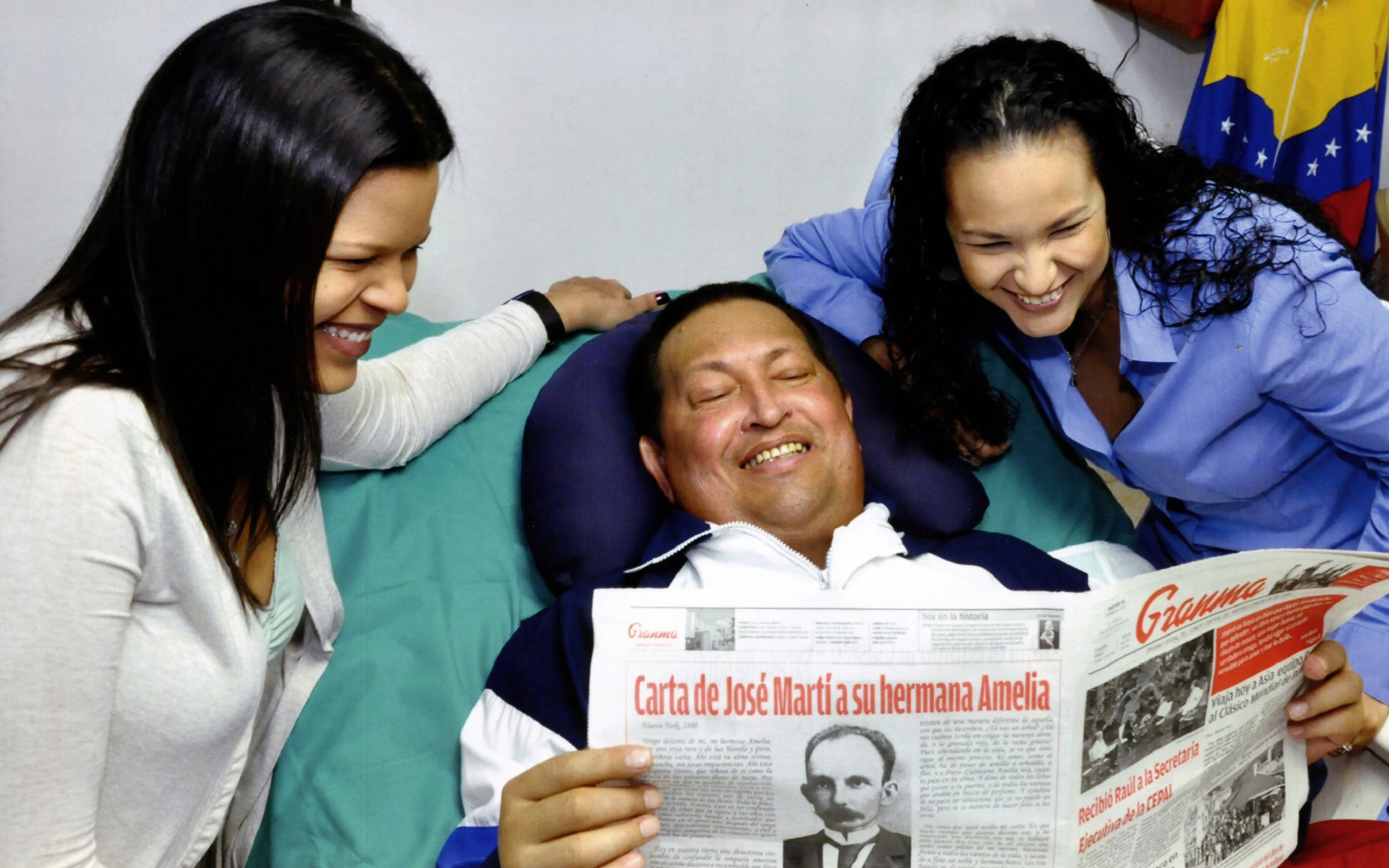 |
| Hugo Chávez with his daughters Maria Gabriela (l) and Rosa Virginia (r) and reading a Cuban Granma newspaper of thursday Feb 14, 2013. Photo released Friday, Feb. 15, 2013 by Venezuelan Miraflores Presidential Press Office |
Tuesday, February 12, 2013
The End Of The Chávez Era?
President Chávez hasn't been seen or spoken publicly since that sudden departure to Havana on Dec. 10 2012. Former Vice President Elías Jaua recently said the president has overcome complications including a severe respiratory infection following his Dec. 11 surgery for recurrent cancer in "his pelvic region". The silence for over two months now of a president who used to speak on television almost every day, has led many Venezuelans to wonder why he is unable to say at least a few words to the country by phone. No pictures or even letters or tweets from his hand have been published either. One has to fear that Chávez' condition is far worse than everyone expected.
Tuesday, January 22, 2013
US Firearms Trafficking to Mexico
After the Newtown, CT school shooting December 14th 2012, discussions about gun control blaze again the US. The sale of handguns and semi-automatic rifles and assault weapons immediately sky rocketed as it usually does after every mass killing. The US has already many more weapons per person than any other country in the world. For West European, Latin American and Asian countries with strict gun control this is an amazing phenomena and hard to understand. In their experience more guns simply means more killings! Unfortunately it is not very likely that US federal or state laws regarding gun control are going to change very much in the near future, despite Obama's efforts.
One has to fear that ever more guns will be sold to US citizens and that therefore more new and used guns will be trafficked into Latin America.
One has to fear that ever more guns will be sold to US citizens and that therefore more new and used guns will be trafficked into Latin America.
Wednesday, December 12, 2012
What Will Happen in Colombia after Peace with Las FARC?
Since November peace negotiations between President Santos' administration and the FARC have begun in Cuba, much to the regret of hardliner and former president Álvaro Uribe Velez and the Uribistas. Thanks to the Norwegian government who has made considerable efforts in silent diplomacy to bring the two parties to the negotiation table, define the agenda and the road-map. Meanwhile in Colombia, Uribe continues to criticize the peace process, stating that you don't negotiate with terrorists and that the current administration shows more interest in dialogue with "terrorism" than National security. After a period of ignoring Uribe, Juan Manuel Santos has started a first offense to silence Uribe and his followers by stating Uribe sought peace talks with the FARC himself for five years during his two terms.
What would be the chance for the peace process to succeed? What are the consequences of peace? Will there be an all-encompassing peace in Colombia when the FARC will give up its arms? What are the consequences of failure? Interesting questions...
Thursday, November 29, 2012
The Domestic Colombian Armed Conflict Explained In Diagrams
Now peace negotiations between the FARC and the Colombian Government has begun in Havana, the mainstream media is writing a lot about the Colombian conflict. You can read many background articles and analyses on the conflict, however few will give you an accurate and complete overview. The conflict has become very complicated in the 64 years of its existence. 64 years, because I would like to add the 10 years of "La Violencia" (1948-1958). Right after La Violencia, the state began to orchestrate hostilities against socialists. During La Violencia approx. 250,000 people lost their lives and another 250,000 lost their lives in the years after. In those 64 years more actors and forces entered the conflict arena, making the conflict more complicated and therefore ever more difficult to resolve. For a better understanding, I will try here to visualize through diagrams the most important actors and forces of the conflict. Forces and actors have varied in time and strength of course.
Subscribe to:
Posts (Atom)