Showing posts with label Venezuela. Show all posts

Tuesday, November 18, 2014

Venezuela and the Plummeting Oil Price


Venezuela depends on oil sales for over 95% of its export earnings, with the hard currency being used to pay for imports, social programs, external debt and arbitration settlements. As a result the decrease in the price of oil this year has been viewed with concern. Brent crude has fallen from a previously stable US $105 in July down to $78 currently.

Brent Crude Oil Price in USD/barrel from Nov 2013 - Nov 2014


Lower oil prices are an additional strain on Venezuela’s ailing economy. But $75-80 oil won’t send the country into default...yet, but the D-word is being whispered by some analysts.

Wednesday, May 1, 2013

The Still Growing Violence and Crime in Venezuela

With 99.67% of the votes being counted on April 14th, it looks like Nicolás Maduro has beaten Henrique Capriles with 1.49% of the votes (50.61% vs 49.12%) in the presidential elections of April 14th 2013. The gap is 224,739 votes, which is only 112,370 voters that are making the difference. Capriles has called for a full audit of the election results, but it looks like he isn't going to get it. The National Electoral Council (CNE) said it would be legally impossible to carry out. What is agreed upon now is a partial examination of 56% of the votes cast, which is expected to take until June, but what exactly is examined is stil not agreed upon. The remaining 44% had been checked immediately after the election. On April 30 even fistfights have broken out in Venezuela's parliament over the recent disputed presidential election. It is obvious that Maduro and his PSUV campaign team used about the same pre-election fraud tactics  that were applied during the campaign of the 7 October 2012 presidential elections, that Chávez won. And maybe some real election fraud as well, according to Capriles. Maduro has to combat serious corruption crime and violence, but also a real economy that is ever more dependent of future oil sales. This seems like an impossible challenge for someone who has been Venezuela's foreign minister for 6 years and has very little experience in dealing with interior matters. It is very likely that the opposition will petition for a recall referendum in April 2016, after half of Maduro's term has elapsed. However, this blogpost is dealing about the serious violence and crime rates in Venezuela, its causes and Maduro's plans to combat this during his first term.

Tuesday, February 19, 2013

Venezuela Under Hugo Chávez

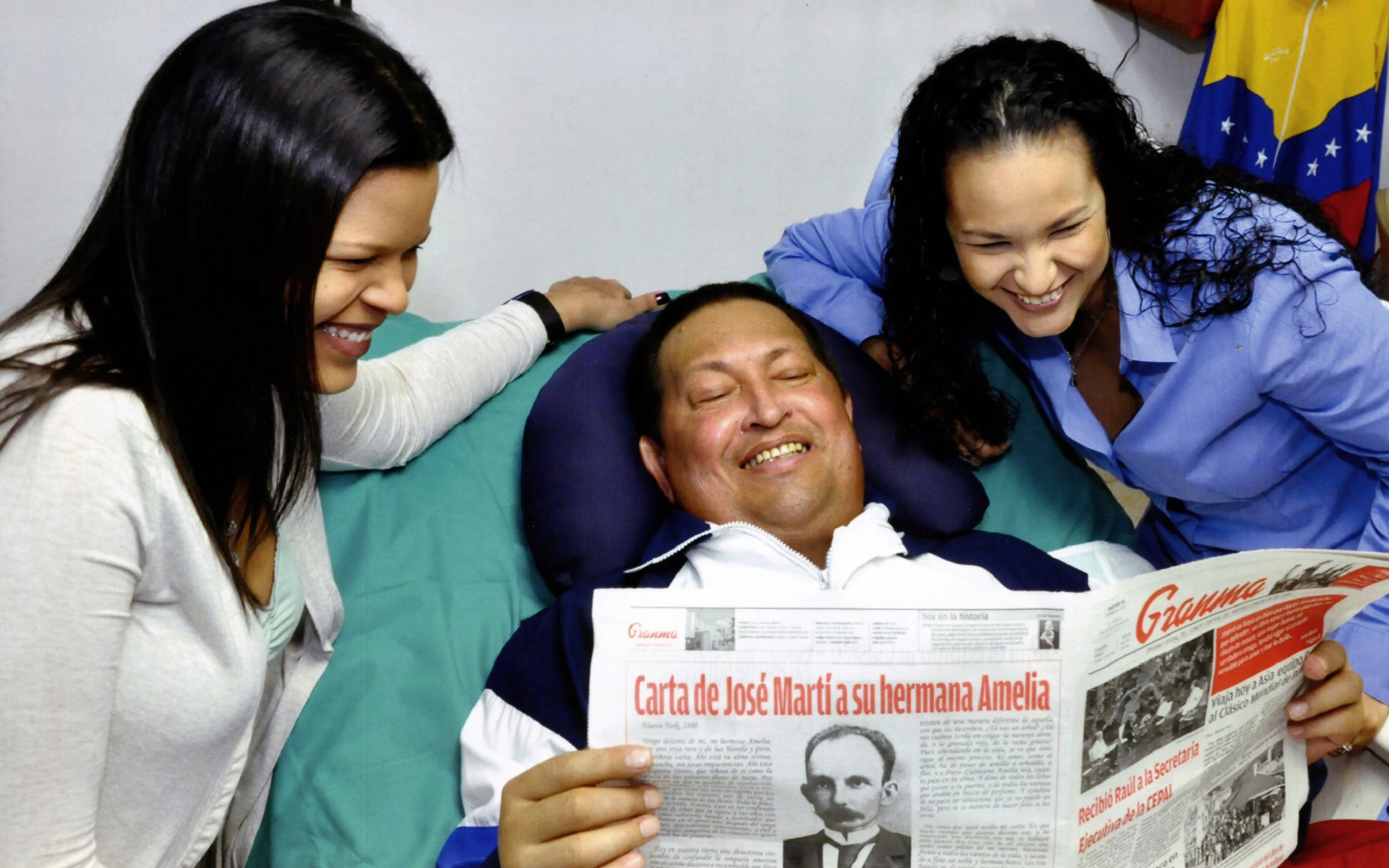
While on Feb 15  2013 - after two months... - the Venezuelan government released new pictures of Hugo Chávez (Why not a video??) including a press release about his medical condition in an attempt to invalidate Spanish ABC's claims, things are still not looking good for Hugo Chávez. Despite that he secretly returned to Venezuela yesterday (February 18th 2013) and kept completely shielded from the outside world.  Because of the seriousness of his disease many Venezuelans are still  awaiting an official declaration that Hugo Chávez is unable to exercise the functions of the presidency anymore and that therefore presidential elections will be held in the next 30 days. It looks like the government is postponing this moment of truth as much as it can. Probably to find monies to finance Maduro's election campaign and to gain time to prepare the campaign. It is a good opportunity to look back at the Chávez era. As a career military officer and a political activist (MBR-200) he led an unsuccessful coup against the Pérez government in 1992 for which he was sentenced for two years imprisonment. Never the less Chávez came legally to power as president on February 2 1999 and was elected as president three more times. He survived a (US supported) coup attempt in April 2002 and also a recall referendum in 2004 with the help of a little election fraud.

Hugo Chávez with his daughters Maria Gabriela (l) and
Rosa Virginia (r) and reading a Cuban Granma newspaper
of thursday Feb 14, 2013. Photo released Friday, Feb. 15, 2013
by Venezuelan Miraflores Presidential Press Office

Tuesday, February 12, 2013

The End Of The Chávez Era?


President Chávez hasn't been seen or spoken publicly since that sudden departure to Havana on Dec. 10 2012. Former Vice President Elías Jaua recently said the president has overcome complications including a severe respiratory infection following his Dec. 11 surgery for recurrent cancer in "his pelvic region". The silence for over two months now of a president who used to speak on television almost every day, has led many Venezuelans to wonder why he is unable to say at least a few words to the country by phone. No pictures or even letters or tweets from his hand have been published either. One has to fear that Chávez' condition is far worse than everyone expected.

Sunday, September 30, 2012

The Pre-Election Fraud of the 2012 Venezuelan Presidential Elections


If you you're in power and sure you have the majority of votes in your country, there is no need to rig elections. If you still do, your attempts could only backfire (Unless  of course when you're not satisfied with simply the majority and you need a 2/3 majority in congress to be able to rewrite the constitution, as has happened in the 2011 Nicaragua elections). Hugo Chávez strengthened the electoral system considerably by introducing voting machines, better laws and procedures. Never the less he still succeeded to rig the results of the intensively negotiated  2004 recall referendum. At the time the exit polls already showed that there was a massive electoral fraud going on.  Strong statistical proof according to two different methods (Benford's Law and Cluster Analysis) came available years later, when the National Electoral Council (CNE), foreign observers and OAS countries had already accepted the results.
Chávez rigged the 2010 Venezuelan parliamentary elections by  applying pre-election fraud referred to as gerrymandering as you can read below. Now facing a close finish with Henrique Capriles in the 2012 presidential elections, Chávez' rigging needs to be even more sophisticated than in 2004 and 2010. Check out the rest of this blogpost to find out about these methods.

Tuesday, November 15, 2011

Oil Production in Venezuela and Colombia

While Venezuela's oil reserves are immense, its oil production is seriously decreasing for years now. On the other hand Colombia's oil production is increasing rapidly. This topic has been covered by most mainstream media, like Washingtonpost, LAtimes and many others. But what's the real in-depth story behind this remarkable phenomena?

Monday, October 3, 2011

The Need and Financing of Venezuela's recent Weapon Purchases

While most NATO partners are cutting defense budgets because of the economic crisis and their activities in Iraq and Afghanistan, the arms build up in Latin America is getting stronger. Venezuela and Colombia are the countries that are investing most in new arms lately. Venezuelan President Hugo Chávez’ weapon purchases in recent years that are totaling more than $15 billion already, is creating unrest in Latin America. While President Chávez says that Venezuela has the right to modernize its army, which is of course very true, he also said he wishes to spend $30 billion to modernize the country’s armed forces. But there is something odd going on here.

Tuesday, August 30, 2011

ALBA & Petrocaribe...a Timebomb?

There's this sword of Damocles hanging over the economies of the countries that are profiting from Venezuela's ALBA/PetroCaribe program. The Bolivarian Alliance for the Peoples of Our America (ALBA) was established on December 14, 2004 by Hugo Chávez and Fidel Castro. Venezuela and Cuba sought to create a regional alliance committed to social, political, and economic cooperation and equality. ALBA says it offers an alternative to free trade accords (FTAA), on the basis of three principles: (1) opposition to free–market economic reforms; (2) not limiting the regulatory action of the State in favor of economic liberalization; (3) harmonizing relations between the State and the market.

Friday, August 19, 2011

Was Simon Bolívar "the" Libertador of Venezuela?

Hugo Chávez
(Courtesy of Agência Brasil)

Hugo Chávez' great inspiration and example - the Venezuelan aristocrat Símon Bolívar - is undoubtedly South America's most famous Libertador. Together with other Libertadores, he led Bolivia, Colombia, Peru, Ecuador, Panama and Venezuela to independence. However, he wasn't the first liberator nor the only one. All together about 14 Libertadores freed South America from Spanish and Portuguese dominion. Today, Venezuelans are still very proud that Bolívar liberated that many countries in South America and in these liberated countries he is still honored very much. Many, many biographies have been written about Bolívar and their hagiography level is usually much higher than the historical level. But let us take a closer look to what Simón Bolivar really meant for Venezuela's independence.