Rafael Correa is Ecuador's president since January 15th 2007. He is smart and very well educated. He earned a Master of Science in Economics and PhD in economics. He published several books and scientific articles. He considers himself a Christian, humanitarian leftist. During his term Ecuador's public and external debt have decreased considerably leaving Ecuador with relatively small debt now. However because of defaulting on $3.2bn in global bonds in 2009, Ecuador cut itself off from capital markets and multilateral lenders such as the World Bank and the International Monetary Fund. To date, Correa’s administration has succeeded in reducing high levels of poverty, indigence, and unemployment. He is known as confrontational, but also as bona fide. So what's the full story on freedom of speech in Ecuador?
Wednesday, November 30, 2011

Thursday, November 24, 2011
Otto Pérez Molina - President-elect of Guatemala
Otto Pérez Molina (Partido Patriota) won the 2011 presidential elections in Guatemala with 53.74% of the votes and voter turnout 60.83% in the second round. He beat Manuel Baldizón (Libertad Democrática Renovada, LIDER, a centrist political party founded in 2010), who got a 46.26% of the votes. Security, combating violence, impunity and social programs played an important role in the campaigns. To be able to interpret the new situation in Guatemala we have to look at Guatemala's history and study the past of Otto Pérez Molina...
Sunday, November 20, 2011
Something Smelly in Nicaragua...The Rigging of the Fraudulent 2011 Elections in Nicaragua Unveiled
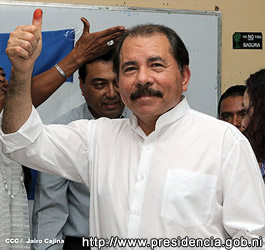 |
| Daniel Ortega - Red thumb up! |
I did blog already here about FSLN pre-election fraud on the November 2011 Nicaragua presidential elections. It's not the first time that election fraud occurred in Nicaragua. The 2008 Municipal election fraud had serious consequences; lots of foreign economic aids were suspended. After 100 % of the votes of this year's elections were counted, the Electoral Council said that Ortega had 62.46% of the vote and the Liberal Party's Fabio Gadea had 31%. While Ortega won the 2011 elections with a staggering 62.46 % of all votes, I would like to point out here all irregularities and suspected fraud. For a start, here is what all accredited and unaccredited, domestic and foreign observers had to say about the elections:
Tuesday, November 15, 2011
Oil Production in Venezuela and Colombia
While Venezuela's oil reserves are immense, its oil production is seriously decreasing for years now. On the other hand Colombia's oil production is increasing rapidly. This topic has been covered by most mainstream media, like Washingtonpost, LAtimes and many others. But what's the real in-depth story behind this remarkable phenomena?
Wednesday, October 12, 2011
Corruption in Latin America
My blogpost about Brazil and its struggle to combat corruption, made me curious about corruption-levels in other Latin American countries. I was interested in historical data to evaluate each country. I wanted to know in which countries corruption is increasing or decreasing and in which countries corruption-levels remain more or less stable.
Friday, October 7, 2011
Brazil's Anti-Corruption Struggle
Brazil won the right to host the 2014 FIFA World Cup tournament on 30 October 2007 as the only country that was left to enter a bid. On October 2, 2009 Rio de Janeiro was officially announced to host the Olympic Games 2016. These two upcoming world events put great pressure on the country not only to make it a success, but Rio has to put its very best foot forward, because it will be in the World's spotlight.
Monday, October 3, 2011
The Need and Financing of Venezuela's recent Weapon Purchases
While most NATO partners are cutting defense budgets because of the economic crisis and their activities in Iraq and Afghanistan, the arms build up in Latin America is getting stronger. Venezuela and Colombia are the countries that are investing most in new arms lately. Venezuelan President Hugo Chávez’ weapon purchases in recent years that are totaling more than $15 billion already, is creating unrest in Latin America. While President Chávez says that Venezuela has the right to modernize its army, which is of course very true, he also said he wishes to spend $30 billion to modernize the country’s armed forces. But there is something odd going on here.
Tuesday, August 30, 2011
ALBA & Petrocaribe...a Timebomb?
There's this sword of Damocles hanging over the economies of the countries that are profiting from Venezuela's ALBA/PetroCaribe program. The Bolivarian Alliance for the Peoples of Our America (ALBA) was established on December 14, 2004 by Hugo Chávez and Fidel Castro. Venezuela and Cuba sought to create a regional alliance committed to social, political, and economic cooperation and equality. ALBA says it offers an alternative to free trade accords (FTAA), on the basis of three principles: (1) opposition to free–market economic reforms; (2) not limiting the regulatory action of the State in favor of economic liberalization; (3) harmonizing relations between the State and the market.
Wednesday, August 24, 2011
Ortega's 2011 Campaign Strategy
 |
| Daniel Ortega |
I agree greatly on the opinion that Ortega is probably going to win this year's election, simply because he's the least worst choice for most Nicaraguans. Despite the widespread corruption, Ortega's illegal acts, breakdown of the democracy, his pacts, his orchestrated election fraud and so on. Remember, it's the wealthy and educated Nicaraguan (and gringo) who can afford to look further in Nicaragua's future and to fear for the deterioration of its democracy; for the surviving Nicaraguan the foreseeable future is probably much shorter and therefore he's obviously more interested in the short term gains that Ortega is offering. These gains are a growing economy (4.5% in 2010 and about the same for 2011), huge ALBA monies still coming in, social programs, friendly investors climate and an upgrade of Nicaragua's infrastructure.
Tuesday, August 23, 2011
The Balloon Effect
 |
| Coca eradication |
Friday, August 19, 2011
Was Simon Bolívar "the" Libertador of Venezuela?
 |
| Hugo Chávez (Courtesy of Agência Brasil) |
Hugo Chávez' great inspiration and example - the Venezuelan aristocrat Símon Bolívar - is undoubtedly South America's most famous Libertador. Together with other Libertadores, he led Bolivia, Colombia, Peru, Ecuador, Panama and Venezuela to independence. However, he wasn't the first liberator nor the only one. All together about 14 Libertadores freed South America from Spanish and Portuguese dominion. Today, Venezuelans are still very proud that Bolívar liberated that many countries in South America and in these liberated countries he is still honored very much. Many, many biographies have been written about Bolívar and their hagiography level is usually much higher than the historical level. But let us take a closer look to what Simón Bolivar really meant for Venezuela's independence.
Subscribe to:
Posts (Atom)